
Ancient Egypt and Numerology: The Hidden Power of Numbers

Updated: Aug 21
By Fibi | Numerologist & Kabbalistic Numerology Consultant
Reading time: Approximately 7–8 minutes
When most people think about Ancient Egypt, images of towering pyramids, magnificent temples, mysterious hieroglyphs, and powerful pharaohs immediately come to mind. For thousands of years, this extraordinary civilization has fascinated historians, archaeologists, and spiritual seekers alike.
Yet beyond its breathtaking monuments lay something even more intriguing—a culture deeply connected to symbolism, sacred knowledge, and the hidden language of numbers.
To the ancient Egyptians, the universe wasn't random. Every star in the night sky, every flood of the Nile, every season, and every cycle of life reflected a greater cosmic order. Numbers were believed to be part of that divine design, offering insight into both the visible world and the unseen spiritual forces guiding it.
Although modern numerology has evolved through many cultures over thousands of years, many researchers believe Ancient Egypt played an important role in shaping the spiritual understanding of numbers that later influenced civilizations across the world.
Today, those same ideas continue to inspire people seeking greater clarity, purpose, and self-understanding through numerology and other spiritual traditions.
Numbers Were More Than Mathematics
For the ancient Egyptians, numbers served a purpose far beyond counting or measuring.
They believed numbers expressed the natural harmony of creation itself.
Every aspect of life appeared to follow repeating cycles and carefully balanced patterns. The rising of the sun each morning, the annual flooding of the Nile River, the changing constellations, the lunar calendar, and even the growth of crops all reflected an underlying rhythm that seemed impossible to ignore.
Rather than viewing these patterns as coincidence, Egyptian priests saw them as evidence of divine intelligence working throughout the universe.
Numbers became a sacred language—a bridge connecting the physical world with the spiritual one.
Understanding these patterns wasn't simply an intellectual exercise. It was believed to help people live in greater harmony with nature, the gods, and their own destiny.
Perhaps this is one reason Egyptian civilization flourished for so many centuries. Their wisdom encouraged people to observe, reflect, and recognise that life itself followed an extraordinary order.
The Spiritual Meaning Behind Egyptian Numbers
Like many ancient traditions, Egyptian culture attached symbolic meaning to specific numbers.
Although historians continue to debate the exact interpretations used throughout different periods of Egyptian history, several numerical themes appear repeatedly in mythology, architecture, and religious ceremonies.
Number 2 – Balance and Duality
The number 2 represented harmony through opposites.
Day and night.
Life and death.
Masculine and feminine.
Earth and sky.
Rather than seeing opposing forces as enemies, Egyptian spirituality viewed them as complementary energies that created balance within the universe.
This idea remains surprisingly relevant today. Much of our own personal growth comes from learning to balance strength with compassion, logic with intuition, and ambition with inner peace.
Number 3 – Completion and Creation
The number 3 symbolised wholeness, creativity, and completion.
Many Egyptian families were traditionally portrayed as a father, mother, and child—a complete family unit representing continuity and new life.
Throughout mythology, groups of three frequently appeared as symbols of stability and divine order.
Even today, many spiritual traditions continue to associate the number three with growth, creation, and the natural cycle of beginning, middle, and completion.
Number 7 – Mystery and Spiritual Power
Among the most spiritually significant numbers was 7.
It appeared repeatedly in rituals, myths, sacred ceremonies, and religious symbolism.
Across many cultures, seven has become associated with wisdom, divine protection, spiritual awakening, and inner transformation.
Although each civilization interpreted it differently, its recurring appearance throughout history suggests humanity has long recognised something uniquely meaningful about this number.
Even in modern numerology, seven continues to represent introspection, higher knowledge, intuition, and the search for truth.
Number 12 – Cosmic Order
Another important number was 12.
The Egyptians divided both day and night into twelve parts, creating a system of measuring time that still influences the modern world.
The number also reflected cycles, completion, and the organised movement of the heavens.
Looking back, it's remarkable how many ancient civilizations associated twelve with cosmic order—a reminder that human beings have always searched for patterns connecting earthly life with the universe above.
The Spiritual Meaning Behind Egyptian Numbers
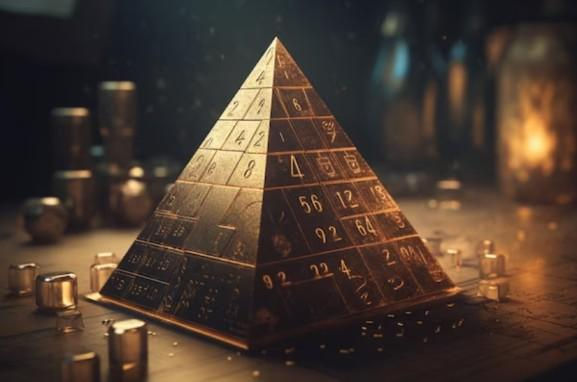
Perhaps nowhere is Egypt's extraordinary relationship with numbers more visible than in the construction of the Great Pyramids.
Even today, these remarkable structures continue to puzzle engineers, mathematicians, and historians.
Their proportions, orientation, symmetry, and astronomical alignment demonstrate an astonishing understanding of mathematics and geometry.
Many researchers believe the builders intentionally incorporated sacred numerical relationships into their designs.
Whether every theory surrounding sacred geometry is historically accurate remains debated, but there is little doubt that mathematics played a central role in Egyptian architecture.
For the Egyptians, geometry wasn't merely practical.
It reflected harmony.
Balance.
Perfection.
The same principles they believed governed the universe itself.
This beautiful connection between mathematics and spirituality continues to inspire numerologists, architects, and researchers around the world.
Names, Identity, and Destiny
Ancient Egyptians also believed names carried extraordinary power.
A person's name wasn't simply a label—it represented identity, spiritual essence, and even immortality.
To have one's name remembered meant continuing to exist beyond physical life.
Because of this belief, names were carefully preserved on monuments, temples, and tombs throughout Egypt.
This ancient perspective shares fascinating similarities with modern numerology.
In Kabbalistic Numerology, every letter carries numerical significance. Together, the letters of a person's name reveal symbolic patterns connected to personality, natural abilities, emotional tendencies, life lessons, and spiritual purpose.
While today's systems differ greatly from those used thousands of years ago, the underlying idea remains remarkably similar:
Names carry energy.
And numbers help us understand that energy.
Ancient Egypt's Influence on Modern Numerology
Modern numerology didn't emerge from one single civilization.
Instead, it gradually evolved through the combined wisdom of Ancient Egypt, Babylon, Greece, Jewish mysticism, and several other spiritual traditions.
Each culture contributed something unique.
The Babylonians explored celestial cycles.
The Greeks developed mathematical philosophy through Pythagoras.
Hebrew mysticism deepened the relationship between letters and spiritual symbolism.
And Ancient Egypt demonstrated how numbers could reflect harmony, balance, and divine order throughout every aspect of life.
Together, these traditions laid the foundation for many of the numerological systems still practiced today.
Kabbalistic Numerology and the Wisdom of Numbers
One of the areas I specialise in is Kabbalistic Numerology, which combines the spiritual teachings of Kabbalah with the symbolic language of numbers.
Within this tradition, numbers are not viewed as predictions or fixed destiny.
Instead, they become tools for self-understanding.
Your birth date and your name create a unique numerical blueprint that can reveal personality traits, emotional patterns, natural talents, life challenges, and opportunities for growth.
Rather than telling us what will happen, numerology helps explain why certain experiences may continue appearing throughout our lives.
In my experience, this deeper awareness often brings something people have been searching for all along:
Clarity.
When we begin recognising the patterns within our own lives, we often discover that many things which once seemed random suddenly begin making sense.
Why Ancient Egyptian Wisdom Still Inspires Us Today
Thousands of years have passed since the age of the pharaohs.
Empires have risen and fallen.
Technology has transformed the world in ways the ancient Egyptians could never have imagined.
Yet one thing hasn't changed.
People are still searching for meaning.
We still wonder why certain relationships change our lives.
Why challenges repeat themselves.
Why some paths feel naturally aligned while others never seem quite right.
Perhaps this is why numerology continues to fascinate so many people.
It gently reminds us that beneath the surface of everyday life, there may be patterns waiting to be discovered.
Whether viewed as a spiritual practice, a tool for personal development, or simply another way of understanding ourselves, numerology invites us to slow down, reflect, and see life from a wider perspective.
Final Thoughts
The legacy of Ancient Egypt extends far beyond its pyramids and temples.
It lives on through its remarkable search for harmony, sacred knowledge, and the hidden order woven throughout the universe.
Although we can never know exactly how Egyptian priests understood every numerical symbol, their fascination with mathematics, astronomy, spirituality, and cosmic balance helped shape traditions that continue to inspire us thousands of years later.
In my own work as a Kabbalistic Numerologist, I combine these timeless principles with the wisdom of Kabbalah to help people better understand themselves, their relationships, and the unique path their soul has chosen.
Numbers do not remove our freedom to choose.
Instead, they offer another way of seeing ourselves—with greater awareness, deeper compassion, and a clearer understanding of the journey we're walking.
Perhaps that's the true hidden power of numbers.
Not that they predict our future...
But that they help us understand ourselves well enough to create it with greater purpose.
Stay Connected
Thank you for taking the time to read this article. If you enjoyed it and would like to continue exploring the wisdom of Kabbalah, Kabbalistic Numerology, relationships, and personal growth, I'd love to stay connected. Follow me on Instagram for daily inspiration, spiritual insights, and numerology guidance:
Join me on Facebook for new articles, educational content, and updates:
If this article inspired you or sparked questions about your own life path, you're also welcome to get in touch to book a personal consultation. I'd be honored to be part of your journey toward greater clarity, purpose, and self-discovery.
Continue Exploring
If you're fascinated by how numbers have shaped human understanding throughout history, you may enjoy reading our article on The History of Numerology in Ancient Cultures and exploring the spiritual traditions discussed in Discovering Kabbalah: A Journey into Spiritual Wisdom.


Comments